
Pennies On My Piano
Copyright © 2011 oliveriancross.com
Before we get into chord progressions, let me first explain scale degrees, their names and their functions. The best way to do that is with some sort of visual. Take seven pennies over to a piano or other keyboard and place one of the pennies on middle C (the C-note closest to the middle of the keyboard). This represents our 1 tone or Tonic. Then count up 3½ steps (a perfect 5th)to G, which is called the dominant and place a penny there. Then count down a perfect 5th from middle C to the F which is our subdominant and place a penny there. It is called subdominant because it is the same distance below the tonic as the dominant is above it (sub=below). Count the white keys between the pennies and you will see this. Now count up from middle C 2 steps (a Major 3rd) and place a penny on the E. This is called the mediant (latin for in the middle) because it is half-way between the tonic and the dominant. Then count down from middle C 1½ steps and place a penny on that A. This is called the submediant because it is halfway between the tonic and the subdominant. If you have placed the pennies correctly you will have five pennies evenly spaced on white keys of the keyboard with an empty key in between every other penny. From left to right you should have pennies on F, A, Middle-C, E and G. This Leaves two more pennies to place on two more keys. Place a penny ½ step below the Middle C on B. This is called the leading tone because of its tendency to lead or point back to the tonic. In some scales such as the natural minor, the seventh tone is not directly next to tonic but a full step below it. This lessens its ability to function as a leading tone and wrecks the usefulness of some popular chord progressions. In these cases it is not called a leading tone but the subtonic. This is why other minor scales, which are alterations of the natural minor scale, were devised and why they share the same key signature with their parallel natural minor. And finally place a penny on the note 1 step above the tonic which in this example is D. This is called the supertonic. The supertonic is 1 step above the tonic and the subtonic is 1 step below the tonic.
The names of the scale degrees apply to their corresponding chords. In other words, since the “one” note is called the Tonic note, then the “one” chord is likewise called the Tonic chord and so on. It is important to be familiar with these names because they are often used to refer to chords and scale degrees. However for the purpose of discussing chord function and chord progressions it will be more practical to refer to chords and chord progressions by their corresponding roman numerals.
Chord progressions
A chord progression is simply a succession of two or more chords. When placed in proper order a chord progression will:
-
Establish a tonality (key center)
-
Emphasize movement within a piece of music
-
Provide contrast between different sections within a piece of music
-
Give sense of finality to the end of a piece music
In most western music chord progressions start with the tonic (or 1 chord), move away from there to a chord (or chords) that emphasizes some type of movement or contrast, then moves to a chord (or chords) that has a strong pull or tendency to resolve back to the tonic, and then finally back to the tonic. Because chords have a tendency to resolve by fifths on their way back to the tonic, movement through chord progressions is highly predictable to someone whose ears and fingers have been trained along the circle of fifths. For this reason most musicians of popular music are taught to practice chords in order around the circle of fifths.
Chord Function Map
Music is composed by interpreting the possibilities (not hard and fast rules) that govern chord function and harmony. Also, writers and musicians have come to rely on many well established chord progressions that have been fine-tuned and road tested by countless great composers and improvisers for well over a century. There are as many different ways to approach composing and improvising and playing as there are musicians but at the center of all it is the “Circle Of Fifths”. The musician who understands the circle of fifths as it relates to chord function and harmony, has at his or her disposal a musical map that will allow them to take a simple chord progression or lead sheet and turn it into music that is as elaborate and beautiful as their imagination can conceptualize (A lead sheet is sheet music that only has the bare bones un-embellished melody of a song notated on a staff and chord symbols written above the staff). To simplify how the circle of fifths works, I have included a chord function map that shows in graphic detail how chords want to resolve down by fifths back to the tonic of a key. Placing the tonic at the bottom this chart shows the usual order of chord resolution by the red arrows straight down the middle. Other common movements are indicated by the red arrows off to the sides of the chart and less common but sometimes used movements are indicated by the blue arrows.

If you were to pick any chord from the circle of fifths and then proceed around the circle counterclockwise, you will see that the order of chord degrees down the middle of the chord function chart is based on the way the keys are arranged around circle of fifths.
-
VII
-
III
-
VI
-
II
-
V
-
I
-
IV
Here is the chart worked out in the key of C Major.

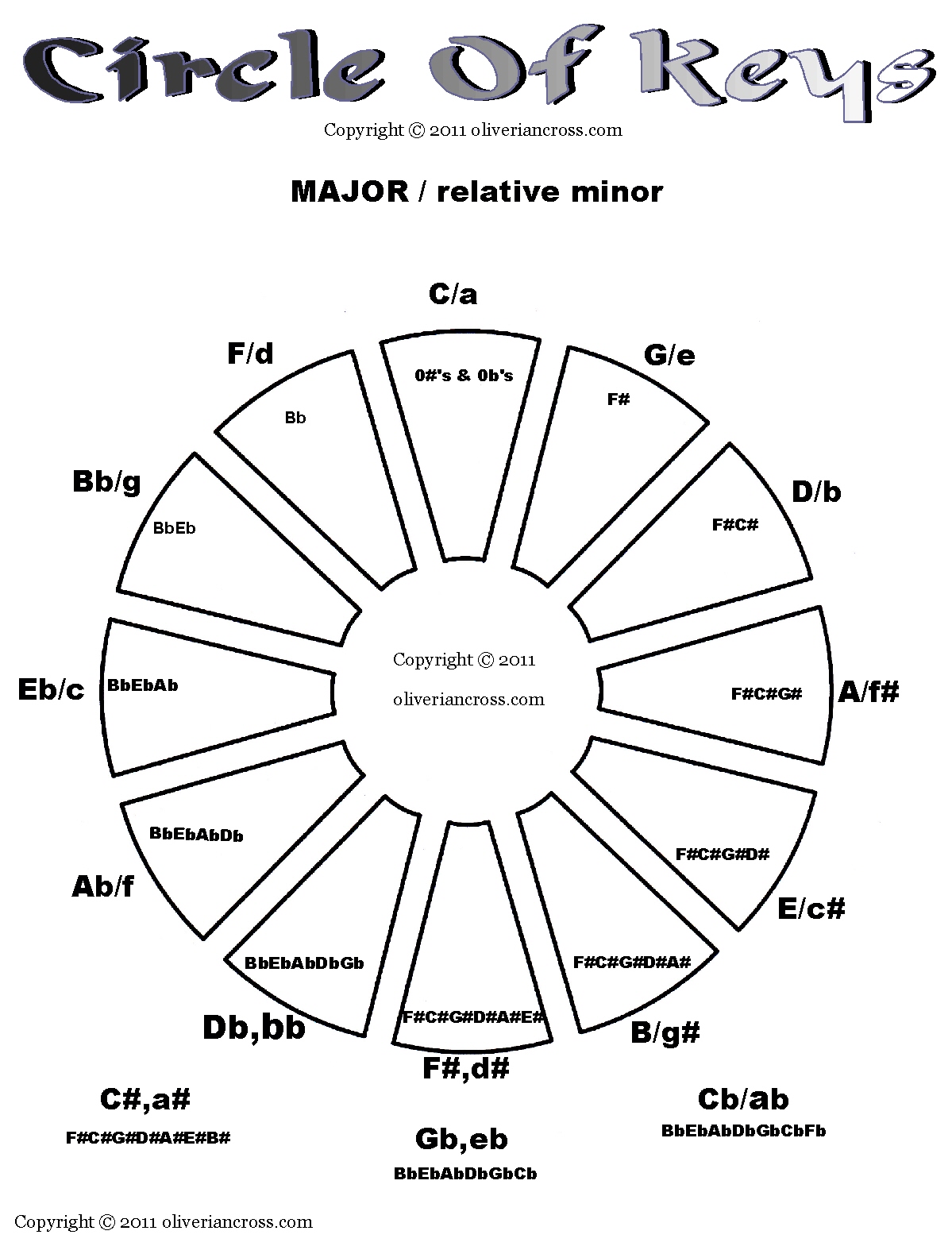
Now compare this with the circle of fifths.
________________________________________________________________________ 
________________________________________________________________________
Choosing C major as your I chord, notice where the VII is. Then the III and the VI and the II and the V and again the I and then the IV. This pattern holds true for all major keys no matter where you start on the circle. This is only barely scratches the surface on the wealth of information that learned musicians regularly extract from the circle of fifths.
Playing The Circle Of Fifths
By utilizing the chord function map you are effectively playing the circle of fifths. To begin with, you start on the I chord (tonic) and then, ignoring the arrows go directly to any chord on the map. Then you simply follow the arrows back to the I chord. The chord function map shown here uses seventh chords in the key of C major but this will also work with triads.
There are countless patterns and sub-patterns that have come into popular use that started out by someone just cruising around the circle of fifths in this way and when you hear musicians refer to chord progressions by numbers such as II-V-I or I-IV-V or III-VI-II-V-I, this chord function movement is what they mean.
This is a basic explanation of how most common chord progressions came into being and although you can cover a lot of mileage musically using just this info, we still have only barely scratched the surface of just how involved chord function is in making music. In the next section we will finally start putting all of our lessons together into a system of playing the piano.
Copyright © 2011 oliveriancross.com
 OLIVER IAN CROSS