
Copyright © 2011 oliveriancross.com
Key vs. Scale
A key is an association of notes that correlate back to one common note for which the key is named.
A scale is a particular sequence of notes in a specific key with a root and a determined pattern of whole and half steps.
Here is a less confusing way to think about it:
-
You will probably play many songs that are in the key of C-Major
-
You will probably also play a C-Major scale many times
- But you will probably never play C-Major scale and call it a song
- A C-Major scale is not a song. And a song, although written in the key of C-Major is not a scale and this is why in music there is a distinction between being a scale and being in a particular key.
Can you see the difference? A scale, like a song, can be “in” a key but a scale is not a key. A scale is only an ordered pattern of whole and half steps founded on a root note. A song in the key of C-major is an arrangement of chords, notes, intervals and sometimes various scales, that are based on the notes of the C-major scale and therefore correlate back to the key note “C”. Melodies, chords, songs, individual notes and even various scales can be said to be “of” or “in” a specific key whereas a scale is only an ordered, determined selection of notes with a specific step pattern that is based on of the root of a key. This is the primary difference between a scale and a key although sometimes the difference can seem like a gray area when trying to explain yourself in musical terms. Before going on, go back to the top of this page and read again the definitions for a chords and scales to see if they make more sense to you now.
In this section we will primarily concern ourselves with the Major scale, Natural Minor Scale and Key Signatures.
__________________________________________________________
Major Scale
As we learned in the lesson on notes, there are actually 12 notes in music and since all scales are based on a step pattern you can start on any key, that means that every type of scale can have 12 possible Major scales. Actually three of the 12 Major scales have enharmonic spellings giving us a total of 15 Major scales.
From any note, a Major scale has a step pattern of:
Whole-Whole-Half-Whole-Whole-Whole-Half.
At the piano, in the key of C, that would be all the white notes and no black notes (no sharps and flats). Because of this the C-Major scale is said to have a key signature with no sharps or flats. A key signature is simply the number of sharps or flats contained in a particular scale or key. The cycle of sharps and flats follow a particular pattern and are better seen with all fifteen keys arranged around a circle. This is known as the Cycle of Keys or the Circle of Fifths. The circle is arranged with C at the top because it has no sharps or flats and then proceeds with the flat keys along one side of the circle and the sharp keys along the other side, in sequential order, from the key with the least number of sharps or flats (1) to the key with the most number of sharps or flats (7). After the key of C, the other keys obtain their successive order of flats and sharps by altering notes of the C-major scale one at a time so for example: starting with F Major, which is the first flat key around the circle and would be in the 11 o’clock position, F Major is actually a C Major scale with the B note flatted to a B-Flat. Its key signature is 1 flat. Next, we have the key of B-Flat which is at the 10 o’clock position and has a key signature of 2 flats. It is the C-Major scale with the B and the E notes flatted to B-Flat and E-Flat. Then the next key around the flat side of the circle is E-Flat which is in the 9 o’clock position and has a key signature of 3 flats. It is a C-Major scale with the B, E, and A flatted to B-Flat, E-Flat and A-Flat. This will continue along through all seven flat keys flatting an additional note of the C scale untill all seven notes Have been flatted. The same process is used for determining the key signatures of all seven of the sharp keys. Starting with the key of G, Which is at the 1 o’clock position and has a key signature of 1 sharp. This is actually the C-Major scale with the F note sharped to F-Sharp. Next is the key of D which is in the 2 o’clock position and has a key signature of 2 sharps. It is a C-Major scale with F and C notes sharped to F-Sharp and C-Sharp. This continues through all seven sharp keys untill all seven notes of the C major scale have been sharped. In this way the C-major scale could be thought of as the foundation of all keys. Here are all the Major scales/Keys with their corresponding flats or sharps in bold type. The total number sharps or flats in each key makes up its “key signature”. For example: Ab Major has a key signature of “4 flats“. That is because it has a total of four flat notes. If you look carefully at the list of scales below, you will notice that the numbers on the left are coincidently the same as the total number of sharps or flats found in each key signature.
From this point on “flat” will be written as (b) and sharp will be written as (#).
C Maj = C,D,E,F,G,A,B,C (no sharps or flats)
Flat Keys
-
F Maj = F,G,A,Bb,C,D,E,F
-
Bb Maj = Bb,C,D,Eb,F,G,A
-
Eb Maj = Eb,F,G,Ab,Bb,C, D
-
Ab Maj = Ab,Bb,C,Db,Eb,F,G
-
Db Maj = Db,Eb,F,Gb,Ab,Bb,C
-
Gb Maj = Gb,Ab,Bb,Cb,Db,Eb,F
-
Cb Maj = Cb,Db,Eb,Fb,Gb,Ab,Bb
Sharp Keys
-
G Maj = G,A,B,C,D,E,F#
-
D Maj = D,E,F#,G,A,B,C#
-
A Maj = A,B,C#,D,E,F#,G#
-
E Maj = E,F#G#,A,B,C#,D#
-
B Maj = B,C#,D#,E,F#,G#,A#
-
F# Maj = F#,G#,A#,B,C#D#,E#
-
C# Maj = C#,D#,E#,F#,G#,A#,B#
Db/C#, Gb/F# and Cb/B are all enharmonic equivalents of each other.
Below is an actual circle of keys. The larger numbers in bold type around the outside perimeter indicate the major key on the left side of the slash and its relative minor on the right side of the slash. We will talk more about what a relative minor is in the next section but for now just think of the relative minor as all the notes of any major scale laid out in order but with the count starting on its sixth note instead of the one. For example: all the notes of C-Major scale on the piano are all the white notes from C to C but if you start on the sixth note (which is A) and then count up from A to A, you would also have all of the notes of the A-minor scale which is the relative minor of C-Major. Every major key has a relative minor which also refered to as the natural minor scale. Next to each key and inside a petal of the circle are the corresponding sharps or flats for each key except for on the bottom of the circle where C#, Gb and Cb ( which are the enharmonic equivalents of Db, F# and B) each sit outside the circle, just below their enharmonic equivalents and just above their corresponding key signatures. The keys and their corresponding key signatures go in order counterclockwise down by fifths and up by fourths…
-
C to F down the piano is an interval of a perfect 5th
-
C To F up the piano is an interval of a perfect 4th
and they go in order clockwise up by fifths and down by fourths…
-
C to G up the piano is an interval of a perfect 5th
-
C to G down the piano is an interval of a perfect 4th
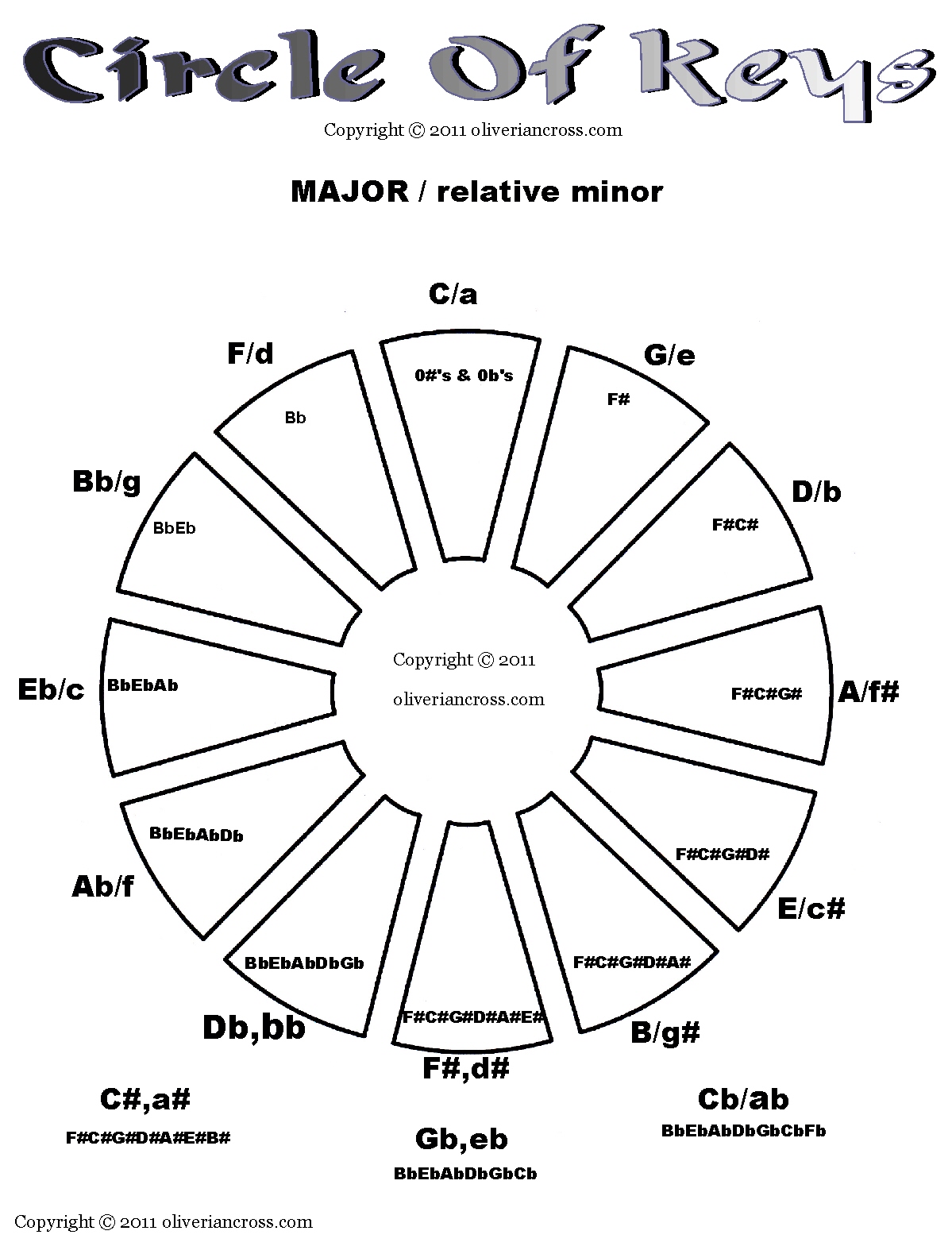
There is a much more to be said about scales and key signatures and the circle of keys but it would be more practical to talk further about these subjects in the context of an actual study on an instrument. We will take all of these subjects and everything we have discussed thus far to the next level when we get into the sections on piano and guitar.
This takes us right into our lesson on modes which we actually touched upon we discussed the natural minor scale. The natural minor scale is the sixth mode or Aeolian mode of every major scale. In the next section I will discuss how and why that is.
Copyright © 2011 oliveriancross.com
 OLIVER IAN CROSS